

Have you ever walked down the street, talked to a friend, and eaten an ice cream cone all at the same time without giving any of those actions a second thought? For most of us, countless actions performed throughout the day happen automatically, without conscious effort. These are not movements we decide to execute step-by-step; rather, they flow smoothly and subconsciously, thanks to intricate neural pathways that have become incredibly efficient over time. But for people with Parkinson’s, these automatic movements can become daily battles.
The key to understanding why these once-effortless actions become challenging lies in a powerful neurotransmitter in our brain: dopamine.
What Is Dopamine, and Why Is It So Important?
Dopamine, a key neurotransmitter, facilitates the planning and execution of our automatic muscle movements. Without sufficient dopamine, these actions become disrupted.
Consider every day movements such as:
- Walking
- Talking
- Swallowing
- Writing
- Getting up from a chair
These automatic movements occur without conscious thought, and their smooth, coordinated execution relies heavily on dopamine.
How Does the Loss of Dopamine in Parkinson’s Affect Movement?
By the time symptoms appear, people with Parkinson’s have lost an estimated 60% to 80% or more of their dopamine-producing cells. This loss means that the brain struggles to produce automatic movements, leading to a range of motor challenges.
In addition, Parkinson’s is characterized by smaller movements which impacts the ability to perform daily actions with ease. Left untreated, smaller movements, such as taking small steps while walking and taking shallow breaths while talking, can cause muscles to become weak. Parkinson’s does not directly attack muscles and make them weaker, but they can become weak simply from not being utilized to their full capacity.
How Does the Loss of Dopamine in Parkinson’s Affect Speech & Swallowing?
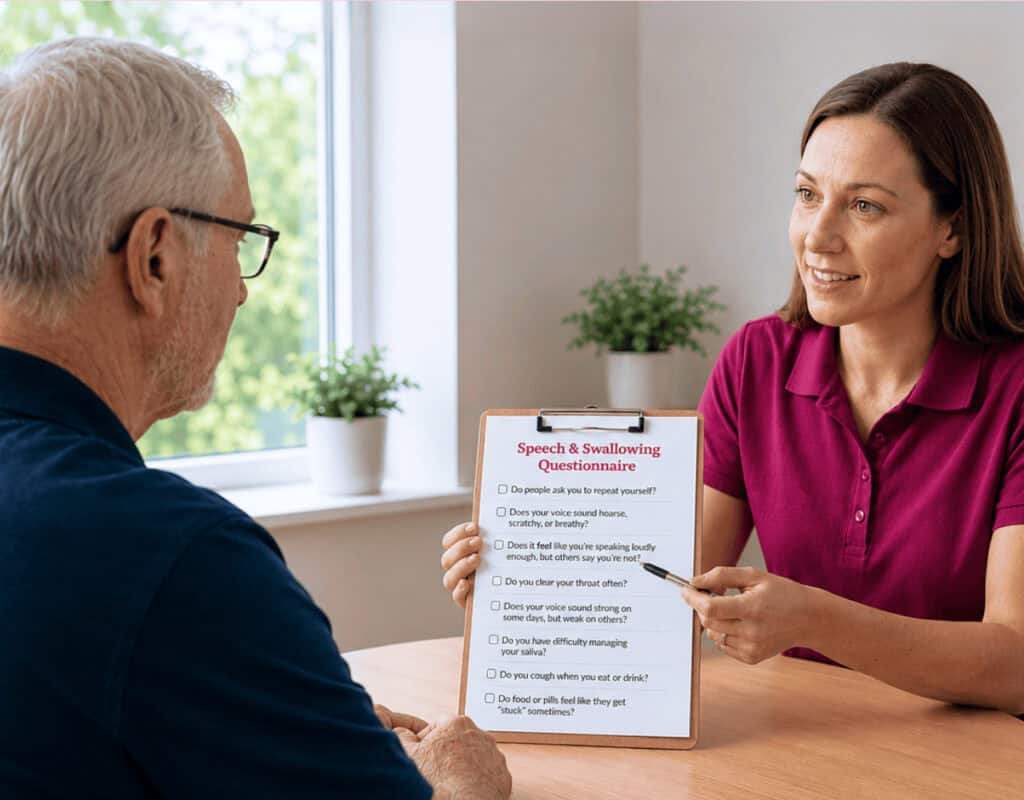
The ability to speak is highly automatic. Before a diagnosis of Parkinson’s, humans regulate their volume, articulate their words, and take the appropriate amount of breath they need to communicate clearly and effectively – all without conscious effort. However, since automatic movements are highly-dependent on dopamine, the loss of dopamine in Parkinson’s leads to communication challenges. An estimated 90% of people with Parkinson’s are likely to develop a speech disorder. Common symptoms include a softer voice, gravely vocal quality, and a flat, monotone voice. Individuals may also experience rapid speech, slurring, frequent throat clearing, trailing off at the end of sentences, and difficulty in regulating their volume. It’s not unusual for someone with Parkinson’s to feel like they’re speaking loudly enough, only to be asked constantly to repeat themselves.
Dopamine loss also affects swallowing, which like speech, used to happen automatically. Challenges with swallowing may appear as drooling, coughing while eating or drinking, feeling like food or pills get stuck, and even unexplained weight loss.
If left untreated, speech disorders lead to frustration, social withdrawal, and diminished quality of life. Swallowing issues result in serious, life-threatening complications, such as aspiration pneumonia. This underscores the critical need for effective interventions that enable individuals to REGAIN and RETAIN control over their speech and swallowing.
Overcoming Parkinson’s Dopamine Challenges Through INTENT
While the insufficiency of dopamine significantly impacts the daily lives of people with Parkinson’s, there still exists a powerful opportunity to overcome these challenges.
Humans have two motor systems:
- The Automatic Motor System: This system, being highly dependent on dopamine, causes a disruption to automatic movements when dopamine levels are low.
- The Intentional Motor System: This system is less dependent on dopamine. This means that when people with Parkinson’s use INTENT – when they are deliberate, focused, and purposeful – they can produce movements that appear more normal.
What does this mean for individuals with Parkinson’s? If they activate the intentional motor system:
- They walk better.
- They talk better.
- They swallow better.
- They write better
- They can get out of a chair better
INTENT is like a light switch that is always available. If you flip the switch, it will work. But, that’s the key. People with Parkinson’s must “flip the switch.”
To better understand the impact of dopamine in Parkinson’s and how SPEAK OUT!® Therapy helps, watch our video: “What is Parkinson’s?” Learning to activate the intentional motor system is the key to proactively managing Parkinson’s and is the main focus of Parkinson Voice Project’s SPEAK OUT!® Therapy Program. This unique, comprehensive treatment teaches people with Parkinson’s how to convert speech from an automatic function to an intentional act. The program begins with a SPEAK OUT! Evaluation with a Certified SPEAK OUT! Provider (a speech-language pathologist who has received specialized training from Parkinson Voice Project). The evaluation is followed by individual SPEAK OUT! Therapy and daily home exercises using a SPEAK OUT! Booklet and online SPEAK OUT! Home Practice Sessions. After a month of therapy, that’s when the maintenance phase of the program begins. Weekly SPEAK OUT! Classes and regular re-evaluations help patients maintain consistency in their home practice. Speech and swallowing are continuously monitored, and additional individual SPEAK OUT! Therapy is re-implemented every six to twelve months. Review our “Circle of INTENT” to better understand how SPEAK OUT! Therapy is a lifelong program. Once someone enters the program, they remain in it for the rest of their lives. Parkinson Voice Project likes to say, “We are in it with you for the long haul!”