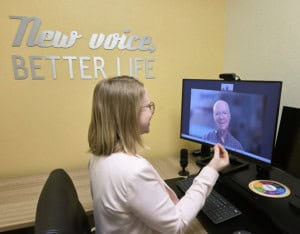


Drooling and saliva management can be a distressing and misunderstood problem for people living with Parkinson’s and their Care Partners.
It is visible. It is uncomfortable. And often, its cause and treatment are not well-understood by others.
Most explanations point to one cause: too much saliva. However, that is not accurate.
Drooling in Parkinson’s is rarely about producing excess saliva. Instead, it is often caused by a decline in swallowing frequency and coordination.
Knowing this distinction helps improve understanding of why drooling happens and how it can be improved.
What Causes Drooling in Parkinson’s?
Drooling, also known as sialorrhea, can be associated with neurological conditions like Parkinson’s. According to Parkinson’s Foundation and Michael J. Fox Foundation, it affects a significant proportion of people with Parkinson’s, sometimes appearing before other motor symptoms become pronounced. Up to 90% of people with Parkinson’s experience speech and swallowing difficulties, challenges that can contribute to drooling over time.
But here’s the key insight:
Most people with Parkinson’s do not produce more saliva than usual.
Instead, the issue lies in how often and how effectively they swallow.
In a healthy system, swallowing happens automatically throughout the day – hundreds of times without conscious effort. This keeps saliva moving from the mouth to the digestive tract. It prevents drooling from happening automatically.
With Parkinson’s, that automatic process begins to slow down.
- Swallowing becomes less frequent
- Movements become less coordinated
- The body’s automatic ability to swallow saliva becomes less reliable
When swallowing happens less frequently and less efficiently, then saliva begins to collect in the mouth, eventually leading to drooling.
Drooling Is a Swallowing Problem, Not a Saliva Problem
This is one of the most important reframes for both people with Parkinson’s and their Care Partners.
When drooling is treated purely as a saliva issue, solutions tend to focus on:
- Reducing saliva production (medications)
- Blocking saliva glands (injections)
While these approaches may offer temporary relief, they do not address the underlying issue: the body is not swallowing often enough.
This is why drooling can persist, or even worsen over time if the root cause is not addressed.
Why Drooling Matters More Than You Think
It is easy to dismiss drooling as a “surface–level” symptom. But in Parkinson’s, it can be an early indicator of declining swallowing function. And that has bigger implications.
Swallowing is not just about saliva. It is essential for:
- Eating safely
- Drinking without choking
- Protecting the airway
As swallowing function declines, the risk of complications increases, including:
- Choking episodes
- Difficulty eating and drinking
- Aspiration (food or liquid entering the airway)
- Aspiration pneumonia, a leading cause of hospitalization and mortality in Parkinson’s
It is important to assess and treat swallowing changes early, before more serious complications arise.
Drooling is often one of the first visible signs that swallowing is changing.
The Progression: What Drooling Can Signal
Drooling doesn’t usually appear overnight. It tends to develop gradually as part of a broader shift in motor control.
Here’s how it often progresses:
Stage 1: Reduced Swallowing Frequency
Swallowing happens less often, especially when at rest or distracted.
Stage 2: Saliva Accumulation
Saliva begins to pool in the mouth due to less frequent swallowing. A person may notice wetness from saliva in the corners of the lips.
Stage 3: Visible Drooling
Saliva spills from the mouth, particularly when sitting, relaxing, or concentrating. There may be just a small amount of saliva noticed outside of the mouth, or there may be larger amounts of drooling that are more noticeable.
Stage 4: Increased Swallowing Difficulty
Eating and drinking may become more effortful or unsafe. At this point, drooling is no longer just a social or comfort issue, it is part of a larger swallowing challenge.
Common Treatments and Their Limitations
Many traditional approaches to drooling focus on reducing saliva itself.
These may include:
- Oral medications that decrease saliva production
- Botulinum toxin injections into the salivary glands
- Behavioral strategies like posture adjustments
While these can be helpful in certain cases, they come with limitations:
- They do not address the root cause of the problem
- They do not improve swallowing function
- Effects may be temporary
- Some treatments can cause dry mouth, which creates new challenges for speaking and swallowing
Most importantly, they do not address the underlying neurological change: reduced coordination and frequency of swallowing.
A Different Approach: Strengthening the Swallow
If drooling is fundamentally a swallowing issue, the most effective long–term approach is to target swallowing directly. This is where speech and swallowing therapy plays a critical role.
SPEAK OUT!® Therapy is designed to address the neurological changes in Parkinson’s by teaching people to speak and swallow with INTENT, shifting from automatic movement to deliberate, purposeful action.
While widely known for improving speech, it is also known to improve swallowing function.
SPEAK OUT! Therapy is delivered by a Certified SPEAK OUT! Provider, a speech–language pathologist with specialized training from Parkinson Voice Project. The program helps people with Parkinson’s REGAIN and RETAIN their speech and swallowing.
How Swallowing Therapy Helps
Swallowing therapy works by retraining the brain and body to:
- Increase swallowing frequency
- Improve muscle coordination
- Strengthen the muscles used for swallowing
Through consistent, guided exercises, people with Parkinson’s can:
- Swallow saliva more effectively
- Reduce pooling in the mouth
- Improve overall swallowing control
Over time, this can lead to a noticeable reduction in drooling – not by reducing saliva, but by restoring the body’s ability to manage it.
The Role of INTENT
One of the core principles behind effective Parkinson’s therapy is INTENT.
In Parkinson’s, automatic movements become impaired. This includes:
- Speaking
- Swallowing
- Facial movements
Therapy helps people shift from automatic to intentional control.
Instead of relying on the body to swallow reflexively, they learn to:
- Swallow with awareness
- Engage muscles fully
- Maintain consistency throughout the day
This approach not only improves swallowing – it supports overall communication and quality of life.
Why Early Intervention Matters
One of the biggest misconceptions about drooling is that it’s something to address later. Early intervention leads to better outcomes.
When therapy begins at the first signs of change:
- Swallowing function can be maintained longer
- Progression can be slowed
- Complications can be reduced
Waiting until swallowing becomes significantly impaired makes improvement more difficult.
Drooling is not just something to manage. It is something to treat and improve directly with the use of INTENT.
What Care Partners Should Look For
Care Partners often notice changes before the individual does.
Here are some early signs to watch for:
- Increased drooling, especially at rest
- Food remaining in the mouth after eating
- Coughing or throat clearing during meals
- A “wet” or gurgly voice
- Longer time needed to finish meals
These signs do not always mean something severe, but they do signal that it is time to take action.
Taking the Next Step
If you or someone you care for is experiencing drooling related to Parkinson’s, it’s important to seek out the appropriate care.
A Certified SPEAK OUT! Provider, a speech–language pathologist with specialized training from Parkinson Voice Project, can evaluate swallowing function and guide next steps. Find a Certified SPEAK OUT! Provider near you and start speaking and swallowing with INTENT today.
A Shift in Perspective
Drooling can feel frustrating, even discouraging. But it’s also an opportunity.
It is a signal from the body – one that, when understood correctly, allows for earlier intervention and better outcomes.
By reframing drooling as a swallowing issue rather than a saliva problem, people with Parkinson’s and their families can move toward solutions that more directly address the underlying cause.
The Bottom Line
Drooling in Parkinson’s is not just about excess saliva. It’s about reduced swallowing frequency and coordination.
And that means:
- It can be understood
- It can be addressed
- And with the right therapy, it can be improved
By focusing on strengthening swallowing function, people with Parkinson’s can REGAIN and RETAIN greater control and independence in their daily activities.