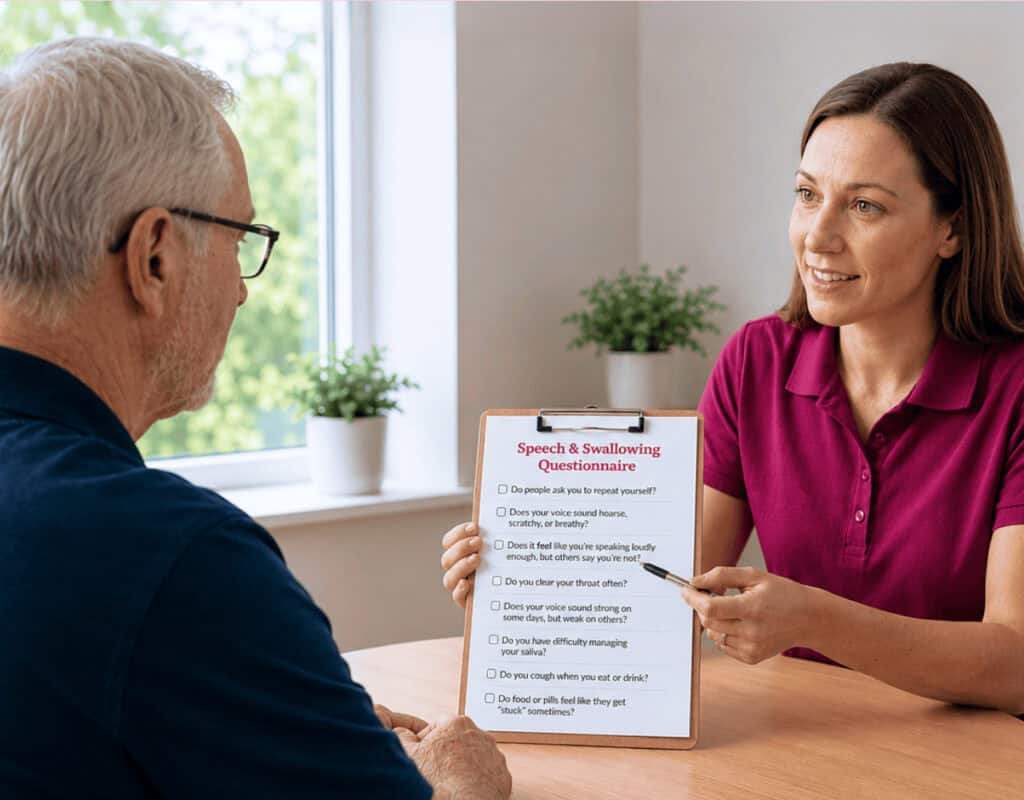


When a person with Parkinson’s speaks quietly, the first assumption is often that they are tired, distracted, or simply not trying hard enough. That assumption is wrong. Softer speech in Parkinson’s is a neurological symptom called hypophonia, and it is one of the most common communication changes associated with the disease.
Hypophonia is not caused by fatigue or a lack of effort. It is a neurological symptom related to changes in the brain and voice system.
Up to 90% of people with Parkinson’s experience changes in speech and voice over the course of the disease. Hypophonia is frequently one of the earliest signs. As speech becomes softer, communication may require more repetition, leading to frustration for both people with Parkinson’s and their Care Partners.
What Is Hypophonia?
Hypophonia refers to reduced vocal loudness. People with hypophonia may sound quiet, breathy, or monotone, especially in group settings or noisy environments.
Hypophonia is commonly associated with hypokinetic dysarthria, the most frequent speech disorder in Parkinson’s disease. This condition affects the muscles involved in speaking, including those responsible for breathing, vocal fold movement, articulation, and facial expression.
Speech changes associated with hypophonia may include:
- Noticeably reduced vocal volume
- A voice that fades out by the end of a sentence
- Breathy or strained voice quality
- Monotone speech with limited pitch variation
- Difficulty being heard in noisy environments or group conversations
- Increased need for repetition during everyday communication
These changes can occur gradually, making them difficult to recognize in the early stages.
Why Does Parkinson’s Cause Softer Speech?
Parkinson’s affects the brain circuits responsible for movement control. Although many people associate Parkinson’s primarily with tremor or walking difficulties, the disease also affects the highly coordinated muscle movements required for speech.
Speaking requires precise control of:
- Breathing support
- Vocal fold movement
- Lip and tongue coordination
- Facial muscle activity
- Timing and motor planning
In Parkinson’s disease, reduced dopamine disrupts these motor pathways. As a result, the muscles used for speech may move with less force and reduced range of motion. The voice becomes softer because the body is no longer generating the same vocal effort automatically.
The same muscle groups involved in speech are also responsible for safe swallowing. When these muscles are affected by reduced dopamine, both speech and swallowing can be impacted.
This reduced vocal output is neurological, not behavioral.
Why Many People Do Not Realize Their Voice Is Softer
One of the most misunderstood aspects of hypophonia is that many people with Parkinson’s do not perceive their speech as quiet. Family members may repeatedly ask them to “speak up,” while the person with Parkinson’s believes they are speaking at a normal volume.
This is not stubbornness or inattentiveness. Parkinson’s can affect sensory processing, creating what is known as a sensory deficit, meaning the brain may incorrectly interpret vocal loudness. A voice that sounds normal to the speaker may sound very soft to others.
Because of this sensory mismatch, people with Parkinson’s often need external feedback and structured therapy to recalibrate what “normal” loudness feels like.
Care Partners frequently describe this as one of the most frustrating communication challenges. Understanding that the issue is neurological rather than intentional can help reduce conflict and encourage more supportive communication strategies.
Why Early Intervention Matters
Many people assume speech therapy should begin only after communication becomes severely affected. In reality, early intervention is associated with better long-term outcomes.
Speech changes in Parkinson’s often progress gradually. Beginning therapy early allows people with Parkinson’s to strengthen vocal effort, maintain communication confidence, and establish a daily practice habit before symptoms become more pronounced.
Without intervention, softer speech can contribute to:
- Reduced participation in conversations
- Social withdrawal
- Increased communication breakdowns
- Difficulty being understood on phone calls
- Reduced independence in professional and social communication
Communication changes can affect independence and quality of life long before speech becomes severely impaired.
How SPEAK OUT!® Therapy Addresses Hypophonia
The SPEAK OUT! Therapy Program, developed by Parkinson Voice Project, helps people with Parkinson’s and related disorders REGAIN and RETAIN their speech and swallowing. The program focuses on speaking and swallowing with INTENT, helping people transition these automatic functions into purposeful, deliberate actions.
People with Parkinson’s are not losing the ability to speak. Rather, the brain requires greater conscious effort to generate adequate vocal loudness and clarity. SPEAK OUT! Therapy trains people to speak with deliberate intent, improving vocal volume, speech clarity, and communication effectiveness.
It stands apart for its Parkinson’s-specific focus, evidence-based approach, and emphasis on ongoing maintenance through weekly SPEAK OUT! Classes.
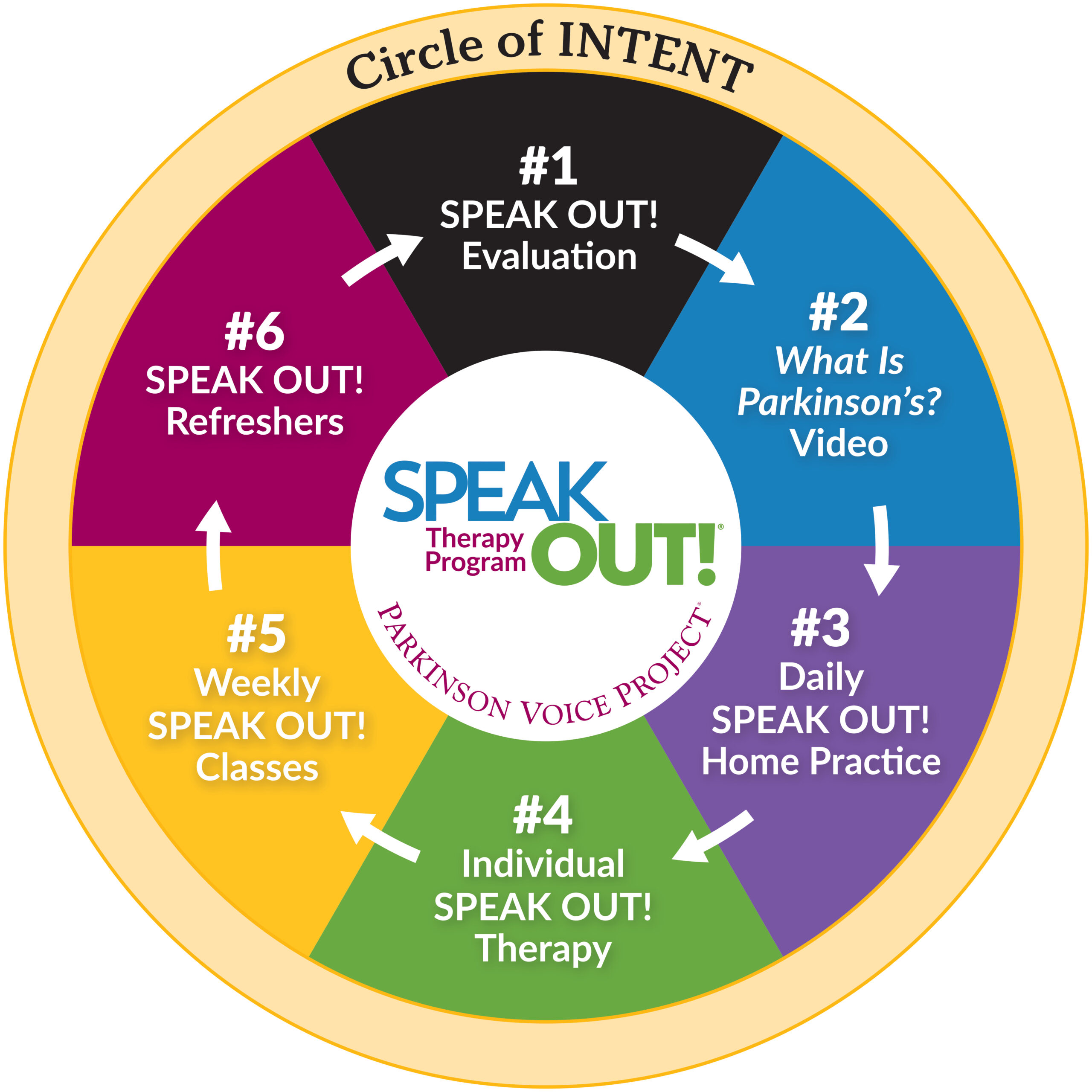
The SPEAK OUT! Therapy Program is illustrated by the Circle of INTENT, a lifelong framework that includes a SPEAK OUT! Evaluation, the informative “What is Parkinson’s?” video, daily SPEAK OUT! Home Practice, individual SPEAK OUT! Therapy, weekly SPEAK OUT! Classes, and SPEAK OUT! Refreshers every 6–12 months. Each component reinforces the others, creating a program that sustains progress over time.
Research has demonstrated improvements in vocal intensity, speech intelligibility, and communication participation following SPEAK OUT! Therapy. Families often notice that conversations become easier, repetition decreases, and confidence during communication improves.
What Care Partners Should Know
Care Partners play an important role in recognizing early speech changes and encouraging treatment.
It is important to remember that softer speech is not caused by laziness, lack of interest, or unwillingness to communicate. Hypophonia is a neurological symptom related to Parkinson’s disease.
Care Partners can support communication by:
- Reducing background noise during conversations
- Facing the person directly while speaking
- Attending individual SPEAK OUT! Therapy sessions to learn the “best cue” to reinforce the use of INTENT
- Establishing a daily routine for SPEAK OUT! Home Practice — choosing a set time and location together
- Offering supportive reminders rather than repeated criticism, understanding that softer speech is neurological, not intentional
- Involving friends and family, so they can understand the power of INTENT
Parkinson Voice Project’s monthly Parkinson’s Family Education Group provides education and support for Care Partners navigating these challenges.
Care Partners should also prioritize their own wellbeing. Communication difficulties can create stress and frustration for the entire family system, making education and support essential.
Looking Ahead
Hypophonia is one of the most common and treatable communication symptoms associated with Parkinson’s disease. Early recognition and evidence-based speech therapy can help people maintain stronger communication skills, social participation, and confidence.
With SPEAK OUT! Therapy, people with Parkinson’s can REGAIN and RETAIN their speech and swallowing. Early intervention allows people to address communication changes proactively rather than waiting until speech difficulties become more severe.
If you’ve noticed changes in your voice or the voice of a loved one, don’t wait. Early intervention is the most effective way to maintain communication
Find a SPEAK OUT! Provider today.