

For people with Parkinson’s, establishing a consistent speech and swallowing Home Practice routine takes planning, but with structure, support, and guidance from a Certified SPEAK OUT!® Provider, daily practice will become an important part of long-term speech and swallowing care.
People looking for guidance on speech and swallowing exercises often find generic lists that are not specific to Parkinson’s. While general information can raise awareness, Parkinson’s-related speech and swallowing changes are complex and require guidance from a trained professional. Daily practice within the SPEAK OUT! Therapy Program is not designed to be a self-directed treatment or to be done alone. Instead, it is part of a structured clinical program to be completed with your Certified SPEAK OUT! Provider. This specialized program was created to help people with Parkinson’s and related disorders REGAIN and RETAIN their speech and swallowing.
Why Daily Practice Matters in Parkinson’s
Parkinson’s affects the nerves and muscles involved in speaking and swallowing. Research shows that up to 90% of people with Parkinson’s will experience changes in speech or swallowing. These changes can occur gradually, making them easy to overlook at first. People may notice softer speech, reduced facial expression, unclear articulation, changes in vocal quality, or swallowing difficulties.
Consistent daily practice is important because Parkinson’s is a progressive neurological condition. Speech and swallowing muscles benefit from regular, intentional use, much like other areas of the body that are affected by Parkinson’s.
SPEAK OUT! Therapy focuses on speaking with INTENT. Rather than simply repeating exercises mechanically, people learn to speak deliberately and purposefully. This approach uses neuroplastic change to activate the intentional motor pathways and helps to strengthen communication habits used in everyday life.
By working with a Certified SPEAK OUT! Provider, people with Parkinson’s may improve:
- Volume
- Articulation
- Breath support for speech
- Vocal quality
- Intonation
- Rate of speech
- Facial expression
People and their families also frequently report improvements in swallowing and reduced drooling.
Daily Home Practice reinforces the work completed during therapy sessions and helps support carryover into conversations, meals, social activities, and daily routines.
What Daily Practice Looks Like in SPEAK OUT! Therapy
One of the most common questions people ask is: “What does daily practice actually involve?”
The answer is structure, consistency, and intentional practice guided by the SPEAK OUT! Therapy Program and your Certified SPEAK OUT! Provider.
The SPEAK OUT! Therapy Booklet
The SPEAK OUT! Booklet, located in the Parkinson Voice Project eLibrary, is designed to guide practice both during sessions and at home. The exercises are sequenced and are completed using INTENT throughout each activity.
Exercises focus on using INTENT in:
- Warm-Ups
- Vocal exercises
- Reading exercises at Level I, II, or III
- Conversation exercises at Level I, II, or III
You will work with your speech-language pathologist, who is also a Certified SPEAK OUT! Provider, to determine the best practice level for you.
Daily Home Practice Sessions
Daily practice is designed to continue outside the therapy room. Home Practice sessions help reinforce the techniques introduced by the Certified SPEAK OUT! Provider and create consistency from day to day.
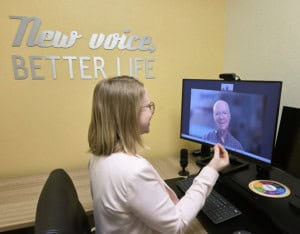
Parkinson Voice Project also offers no-charge online SPEAK OUT! Home Practice Sessions led by speech-language pathologists. These guided sessions allow people to practice alongside others while maintaining the structure of the program at home.
For many people, having a scheduled session helps establish routine and accountability.
Practice Becomes Part of Daily Life
Daily practice does not stop when the exercises end. The principles of INTENT are designed to carry into everyday communication.
People may practice intentional speech while:
- Speaking with family members
- Ordering at a restaurant
- Participating in community events
- Talking on the phone
This carryover is an important part of therapy. The goal is not simply completing exercises, it is improving communication in real-world situations.
Why Self-Directed Exercises Are Not Enough
Many websites offer lists of speech exercises for Parkinson’s. While educational information can increase awareness, exercises performed without clinical evaluation and professional guidance may not address a person’s specific needs.
Speech and swallowing changes vary from person to person. A Certified SPEAK OUT! Provider evaluates specific challenges and develops an individualized therapy plan. The provider also helps people maintain proper technique, exercises when needed, and monitors progress through SPEAK OUT! Refreshers every 6–12 months.
This clinical guidance is especially important for swallowing concerns, which may require additional assessment and safety recommendations.
The Role of Care Partners in Daily Practice
Care Partners play an important role in helping establish and maintain daily routines.
Support may include:
- Helping create a consistent practice schedule
- Participating in Home Practice Sessions together
- Encouraging the use of INTENT during conversation
- Reducing distractions during communication
- Providing encouragement and consistent reminders
Involving Care Partners helps create a supportive communication environment at home and reinforces the strategies learned during therapy.
Involving friends and family can also help them understand the power of INTENT.
Building Consistency Over Time
Consistency is what makes speech and swallowing practice effective over time. Some days will feel easier than others, but the commitment to daily practice is what sustains progress.
People do not need to navigate these changes alone. With support from a Certified SPEAK OUT! Provider, structured Home Practice, and involvement from Care Partners, people with Parkinson’s can continue strengthening their speech and swallowing for the long haul.
Find a Certified SPEAK OUT! Provider
The SPEAK OUT! Therapy Program helps people with Parkinson’s and related disorders REGAIN and RETAIN their speech and swallowing.
Find a SPEAK OUT! Provider near you. Start speaking with INTENT today.