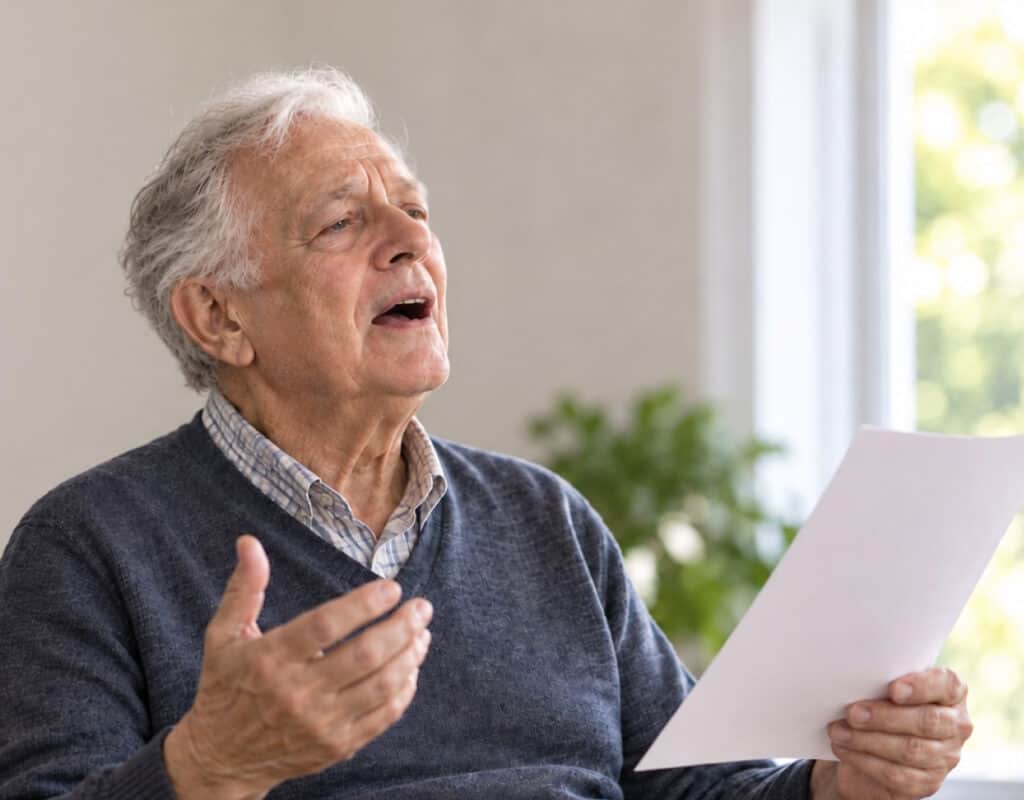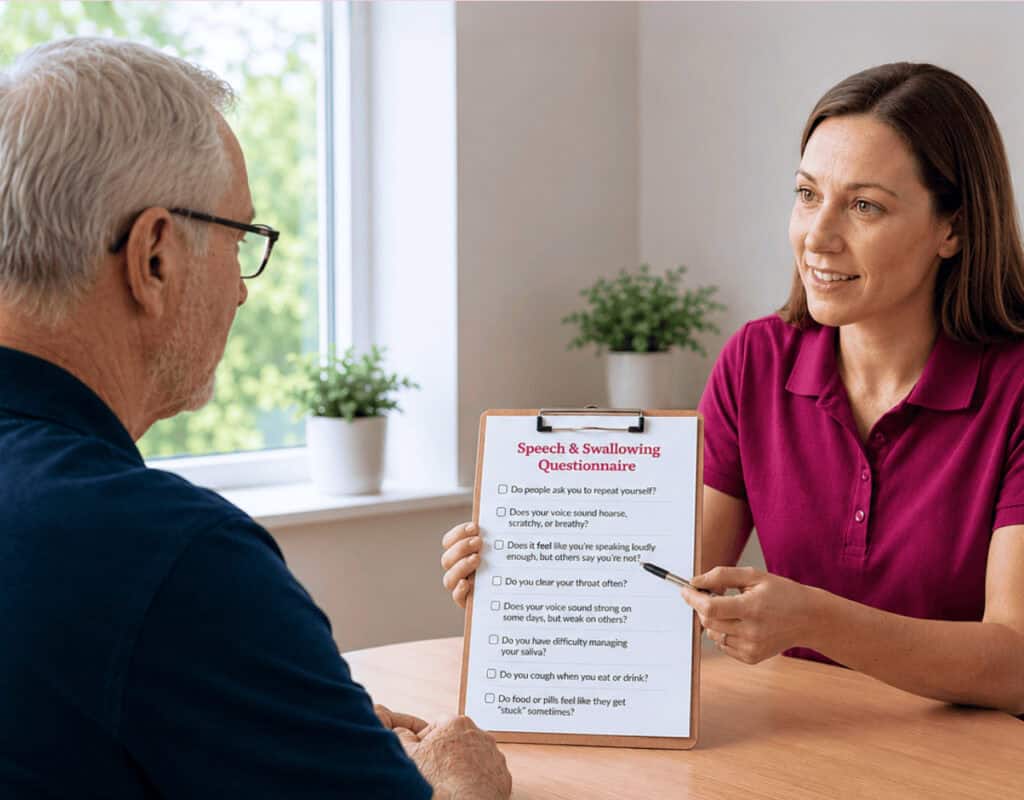


For people with Parkinson’s, facial expressions that once came naturally, like a quick smile, raised eyebrows in surprise, or a look of concern, can become slower, smaller, and less spontaneous. This change, called hypomimia or facial masking, is one of the most misunderstood symptoms of Parkinson’s disease.
Hypomimia, which causes reduced facial movement, can quietly change how conversations are perceived and how relationships function.
With preparation, understanding, and intentional communication, individuals with Parkinson’s and their Care Partners can address this challenge directly.
What Is Hypomimia?
In Parkinson’s, the loss of dopamine-producing neurons disrupts the automatic motor system. Facial movement is an automatic movement: Blinking, smiling in response to good news, and raising an eyebrow in surprise happen without conscious effort in most people. As dopamine levels decline, these movements become slower, have a smaller range, and are less spontaneous.
Hypomimia is a motor symptom. But its consequences are communicative. That distinction matters.
A Communication Symptom, Not Just a Motor One
Researchers estimate that a large proportion of communication is non-verbal. Facial expression is one of its most direct channels.
When the face does not reflect internal emotional states, which is not because feelings are absent but because the motor system cannot move automatically, listeners might draw inaccurate conclusions.
People with Parkinson’s may be perceived as being disinterested or unhappy when they are not.
These misunderstood perceptions may impact communication. The feeling is present, but the automatic motor expression of it is reduced. This mismatch is at the heart of why hypomimia functions as a communication barrier, not just a physical one.
The Social Impact of Reduced Expression
When others consistently misread emotional states, relationships change. Care Partners may feel their loved one is withdrawing. Friends may assume disinterest and reduce contact. Colleagues or acquaintances may find conversations less reciprocal and gradually engage less.
Over time, people with Parkinson’s may begin to withdraw from social situations themselves – not because they want less connection, but because the effort of communicating against repeated misunderstanding becomes discouraging. This is a pattern seen across multiple Parkinson’s communication symptoms: the symptom reduces participation, reduced participation weakens the muscles and skills involved, and the symptom progresses faster as a result. Facial expression was one factor that impacted how leadership qualities were perceived in people with Parkinson’s.
Research has documented that reduced facial expression affects how others perceive competence and leadership. A 2025 study published in the Journal of Clinical Practice in Speech-Language Pathology evaluated perceived leadership qualities in individuals with Parkinson’s before and after the SPEAK OUT!® Therapy Program.
Fifty-six participants rated silent videos of 19 individuals with Parkinson’s. Ratings were highly consistent: participants scored individuals significantly higher on leadership, competence, communication, trust, and confidence after SPEAK OUT! Therapy – a direct result of improved facial expressiveness.
What Care Partners Notice
Care Partners are often the first to observe hypomimia and are frequently the most affected by it. Common observations include:
- The person looks serious or flat even during positive interactions.
- Eye contact has decreased.
- Smiling is less frequent or takes noticeable effort.
- The face does not respond as quickly to laughter or surprise.
- Others outside the family comment that the person “seems different.”
Understanding that these changes are neurological – not emotional withdrawal – allows Care Partners to interpret them accurately and respond with patience rather than hurt or frustration.
The Role of INTENT
One of the core principles behind effective Parkinson’s therapy is INTENT.
In Parkinson’s, automatic movement becomes impaired. This includes:
- Speaking
- Swallowing
- Facial movements
- Blinking
- Gesturing
Instead of relying on facial muscles to move automatically, people with Parkinson’s must use INTENT to move their facial muscles.
- Express with awareness.
- Use conscious effort for expressions.
- Engage facial movements more consistently.
This approach improves masking, swallowing, and speaking and supports overall communication and quality of life.
Practical Strategies for Individuals with Parkinson’s
Practice Facial Movements Deliberately
- Include intentional facial expression in your daily SPEAK OUT! Home Practice routine.
- Use the SPEAK OUT! Booklet and flashcard exercises as your foundation and add facial movement to each session.
Use Verbal Communication to Supplement Expression
- Say what your face may not be showing: “I’m really glad you called.”
- Name your emotional state in conversation when expression may be reduced: “That made me happy.”
- Use direct statements to confirm engagement: “I’m listening” or “That’s interesting.”
Prepare Others in Your Life
- Let family, friends, and colleagues know about facial masking before they misinterpret it.
- Explain that reduced expression is a motor symptom, not a reflection of interest or feeling.
- Invite Care Partners and family to observe SPEAK OUT! sessions so they understand the role of INTENT.
Guidance for Care Partners
Care Partners can support more expressive communication in several direct ways:
- Do not interpret a flat expression as a signal to end a conversation or reduce engagement.
- Ask direct questions rather than reading the face: “Are you enjoying this?”
- Provide cues when helpful, in the spirit of INTENT: “Your smile looks great when you put effort into it.”
- Attend SPEAK OUT! Therapy sessions to understand the exercises and how to reinforce practice at home.
- Participate in online SPEAK OUT! Home Practice Sessions together to keep expression practice consistent.
SPEAK OUT! Therapy and Facial Expression
Improved facial expression is one of the direct outcomes of the SPEAK OUT! Therapy Program. Developed by Parkinson Voice Project, SPEAK OUT! Therapy helps individuals with Parkinson’s and related disorders REGAIN and RETAIN their speech and swallowing. By working with a Certified SPEAK OUT! Provider, people with Parkinson’s improve volume, articulation, breath support for speech, vocal quality, intonation, and facial expression.
The program teaches people to convert automatic movements – including facial expressions – into intentional acts. This is the same principle that applies to every component of SPEAK OUT!: when dopamine-dependent automatic pathways are less reliable, the intentional motor system offers a direct alternative. The more consistently it is engaged through daily practice, the more accessible expressive communication becomes.
Parkinson Voice Project offers online SPEAK OUT! Home Practice Sessions at no charge. The SPEAK OUT! Therapy Program is structured around the Circle of INTENT, a lifelong framework that includes a SPEAK OUT! Evaluation, individual SPEAK OUT! Therapy, daily SPEAK OUT! Home Practice, weekly SPEAK OUT! Classes, and SPEAK OUT! Refreshers every 6–12 months. Involve your friends and family, so they can understand the power of INTENT.
Looking Ahead
By understanding hypomimia as a communication symptom – not an emotional one – and by communicating with INTENT, individuals with Parkinson’s and their Care Partners can reduce the misunderstandings that reduced expression creates and stay fully connected to the people who matter most.